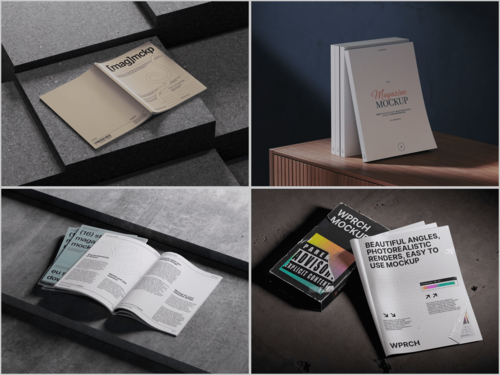
Visitors decide whether to trust a site or leave within seconds. Text persuades slowly, but a dimensional, realistic image works almost instantly. That’s why a Magazine mockup has become a working tool for marketers: it turns a flat PDF or design file into a physically tangible product people want to believe in.
Why “It’s Just a Pretty Picture” Misses the Point
Many articles on this topic make the mistake of reducing everything to “mockups look nice.” In reality, the conversion mechanics are more complex and rooted in perception psychology:
- The materiality effect. The brain trusts objects faster when they have shadow, texture, and perspective — these are “real world” signals, not an abstract file.
- Context of use. A cover shown in hands, on a desk, or stacked with other issues creates a consumption scenario — the visitor mentally “tries on” the purchase.
- Reduced cognitive load. Instead of imagining what a digital product looks like, the visitor immediately sees the finished result.
- A trust anchor. A realistic mockup on a landing page acts as social proof even without real reviews — it visually states: “this is already published, this is professional.”
Without these details, the conversation about mockups stays surface-level, and conversion remains an abstract number without any explanation behind it.
Real-World Use Cases
Let’s look at concrete scenarios where a magazine cover solves a measurable marketing problem.
Independent publishers. A stack of three or four covers on a subscription page visually hints at consistent output — reducing new subscribers’ worry about whether this is a one-off project.
Course creators. A PDF workbook styled as a glossy magazine raises the perceived value of the product before the file is even opened — a classic upsell technique that requires no change to the content itself.
Agencies and freelancers. Presenting a rebrand inside a realistic mockup instead of a flat JPEG helps a client visualize the final printed result and approve the budget faster.
Personal brands. A journalist or expert featured in a publication displays it as a cover mockup on their portfolio — instantly boosting perceived authority in a few seconds of viewing.
E-commerce. A brand selling a digital magazine bundled with a product uses a mockup to “materialize” the intangible part of the bundle and justify the price.
How to Choose the Right Mockup for a Specific Landing Page
Not every mockup delivers the same impact — the effect depends on how well the image fits the page’s context and audience. Before dropping a ready-made scene into a design, it’s worth checking a few parameters:
- Viewing angle. A frontal shot works for product cards, while a diagonal or “in-hand” angle suits emotional, lifestyle-driven landing pages.
- Background color scheme. The mockup should either match the brand palette or intentionally contrast with it, so the cover doesn’t get lost on the page.
- Scene minimalism. An overly detailed background distracts from the cover itself — simpler compositions work better on information-heavy landing pages.
- Match with product format. A glossy magazine style won’t suit a business report — texture and style should match the target audience’s expectations.
This is exactly where much of the effect gets lost: even a high-quality render can “fail” if it visually clashes with the rest of the page’s design instead of supporting it.
Mockups on ls.graphics
ls.graphics offers premium-quality mockups with ultra-realistic rendering of light and paper texture. Files come with organized layers, so swapping a cover takes seconds. The catalog includes many angles, stylish minimalistic compositions, and various color schemes to fit any brand. The Edit Online feature lets you edit directly in the browser, and free scenes let you test the format before buying.
Conclusion
A magazine cover on a landing page isn’t decoration — it’s a working part of the funnel: it builds trust, shortens the path to a purchase decision, and makes an intangible product feel tangible. Understanding perception psychology, along with choosing the right angle, background, and style, explains why these images convert better than flat mockups. Tools like ls.graphics make this effect achievable without a photo studio, while keeping full control over style and brand.